I’ve been doing problem calls for 25 years. People who never bought a stick of wood from us call because they’ve got nowhere else to go. This year I got two calls I’d never had in my whole career. One from upstate New York, one from the West Coast. Same story both times.
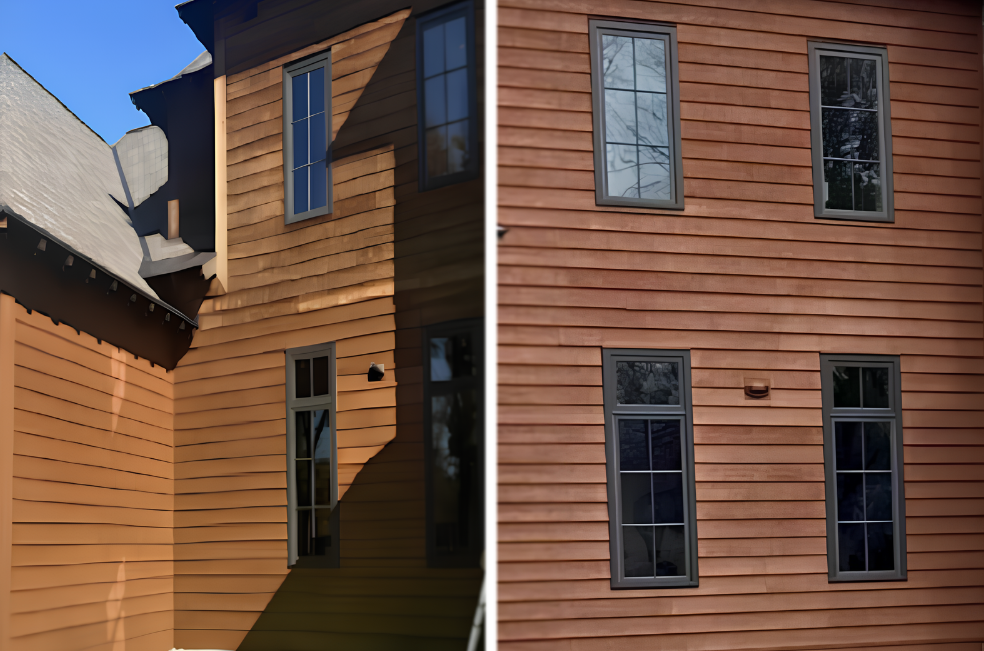
Photos of one of the houses. The painting crew belt-sanded the rough face off all the siding, leaving this gouged and blotchy mess.
A professional painting company couldn’t get the black off the siding, so they decided to sand the whole house. Rough-sawn siding. With belt sanders. Both committed to the entire house. Cedar siding on both houses ruined. Both siding packages have to be replaced.
Let me say this as plain as I can: you do not sand rough-sawn siding. It’s rough. That’s the point. If you want a rough face smoothed, you run it through a planer at a mill. You don’t take a belt sander to somebody’s house. If you need a belt sander to finish wood siding, you’re in the wrong line of work. When we sand wood planks, it’s the smooth face only, by hand, with 80 grit, just enough to open the fibers so it takes stain.
How do you get two feet in and not realize you’re ruining it? How do you get five feet in and keep going? I can’t get my head around it.
How The Black Should Have Been Removed
Cleaning wood for a refinish is a two-step deal:
- Oxygen bleach. Then rinse the hell out of it.
- Oxalic acid immediately following the oxygen bleach. A lot of rinsing, again.
This two-step method is my favorite. When used properly, it works on 99% of the issues that turn wood black. If you don’t do both, or you don’t do them in the right order – oxygen bleach first and then oxalic acid – you’re not going to get the results needed.
Somewhere along the way, people quit doing both steps. No oxalic acid, so the black stays. Then they grab chlorine bleach, because nobody reads past the first line. Chlorine bleach pretends to work. It doesn’t. It can damage wood fibers, break down natural lignin, discolor the surface, and corrode metal fasteners. Now, they’re stuck, and somebody decides to sand.
These homeowners contacted me when their painters couldn't remove the black staining. If they had contacted me before the painters belt-sanded the wood, I would have asked about their cleaning process and suggested re-cleaning with the two-step method. If that didn't remove the black, I would recommend a wood stripper and work with them on hazardous-material management and noxious-chemical cleanup.
Yes, I’m going against my own stance on wood strippers, but if several cleanings with the two-step method don’t remove the black, a wood stripper will. It’s still better than belt-sanding the wood siding to ruin.
My thoughts are these guys didn’t clean the wood properly; they probably didn’t use the oxygen bleach-then-oxalic-acid process. People forget the oxalic acid step. Oxygen bleach only removes the organic stuff and paves the way for oxalic acid to remove inorganic stains caused by copper and metals. Oxalic acid is also an acid neutralizer, so it brings the wood back to a condition where it will accept the finish well.
I’ve coached probably 250 people through cleanup and full-blown restorations, and the black will come off. It may not come off easily, and it may not come off without a wood stripper, but in my 25 years working with finishes, I haven’t run into a situation where you couldn’t get the black off with a properly applied wood stripper.
Both painters suggested painting over the black to cover it up. I’ve had several calls this year about covering the black instead of removing it. Has covering a problem ever been the right solution? If a professional in any endeavor says, “There’s a problem; let’s cover it up,” fire them! That is literally the worst advice you could give; actually, it’s the second-worst advice, next to “hey, let’s go get a belt sander.”
Quick note: If the wood has a water-based film-forming finish, cleaning won’t cut it. You need a wood stripper to get every bit of that film off before you refinish. The painter should know what is currently on the wood to plan the cleaning process correctly for this refinish.
How We Got Here
Before about 2012, you could apply a true oil-based stain to wood in every state in the Union. It worked. Then VOC limits on stains tightened, and not with one national rule. It became a patchwork, with each state setting its own VOC limit. No national brand could sell one formula in all 50 states.
So the big brands rolled out waterborne, film-forming “stains”. Here’s the truth: a film-forming stain is nothing more than a very thin paint. Paint protects itself by its thickness. Thin paint protects nothing. It doesn’t penetrate, so it doesn’t condition the wood. The finish fails, water and sun get behind it, mold and mildew move in, and the wood turns black.
Before 2012, I got about three of these calls a year. By 2014, it was 50 a year. Over and over, I heard the same thing: the same stain for 20 years, the same store, the same shelf, the same can. The only change was a postage-stamp-sized instruction on the label that nobody had a reason to read. One lady had mushrooms growing out of her deck.
Now we’re a generation past that. The kid running the paint crew never saw a stain that actually worked. Nobody told him any of this. So, when the black won’t come off, he reaches for the sander.
What Actually Works
Oil. People have protected wood with oil for thousands of years. A true penetrating oil stain goes into the wood, conditions it on the way, and leaves a face that cleans up and recoats easily. No stripper. It gets better every time you do it.
There are low-VOC true oil stains that are legal in every state now. The one I trust is Expert Stain & Seal out of Tennessee. Restoration guys I know won’t use anything else, and it’s what I spec on commercial jobs. I’ve got homeowners using it now.
The Real Cost of the Low Bid
The West Coast painter was the low bidder, around $15,000. Two guys at $20 an hour made a call on the job site that ruined a $40,000 to $50,000 siding package. Now the homeowner is going after him for all of it. No painting outfit can eat that.
The New York homeowner is one of the best customers I’ve ever had, and she’d already been through a hell of a year. After what her painter did, I told her Hardie Board was the better call for her now. I’ve never said those words in my life; that’s how bad it was.
A low bid is not the best option. The lowest bid is usually somebody who’s going to do it wrong, and fixing it costs ten times more than doing it right. Doing it right would have cost maybe 30% more than the lowest bid.
If You’ve Got Black On Your Wood
- Don’t let anybody near your siding with a sander.
- Ask your painter how they’ll clean it. If the answer isn’t oxygen bleach followed by oxalic acid, keep looking.
- Ask what finish is on there now. If it’s a film-former, you have to strip it off first.
- If someone suggests covering up the black, nope, move on.
- Call us before you call a painter. It’s free to ask, and it’s a lot cheaper than new siding.